The Numbers Don't Lie: How Tampere's Transit Grid Leaves American Car Culture in the Carbon Dust
For most Americans, the morning commute is a solitary ritual: coffee in hand, engine idling, brake lights stretching to the horizon. It is a pattern so deeply embedded in daily life that questioning it can feel almost radical. Yet the moment a traveler steps onto a Tampere tram or boards a regional bus bound for the city center, the contrast becomes impossible to ignore — not merely in comfort or convenience, but in environmental consequence.
The carbon arithmetic, when examined honestly, is striking.
Setting the Baseline: What American Commuting Actually Costs the Planet
The United States Environmental Protection Agency consistently identifies transportation as the single largest source of greenhouse gas emissions in the country, accounting for roughly 28 percent of total U.S. emissions. The private passenger vehicle is the dominant contributor within that category.
The average American commuter travels approximately 27 miles each way to work, predominantly by car. A standard gasoline-powered sedan emits around 404 grams of carbon dioxide per mile under typical driving conditions. Multiply that across a round trip, then across 250 working days per year, and a single commuter is responsible for generating upward of 5.4 metric tons of CO₂ annually from commuting alone — before accounting for weekend driving, errands, or leisure travel.
For context, the global average carbon footprint per person across all activities is estimated at approximately 4 metric tons per year. American commuters, in other words, can exceed the entire global per-capita average through driving to work alone.
Tampere's Transit Network: A Different Equation Entirely
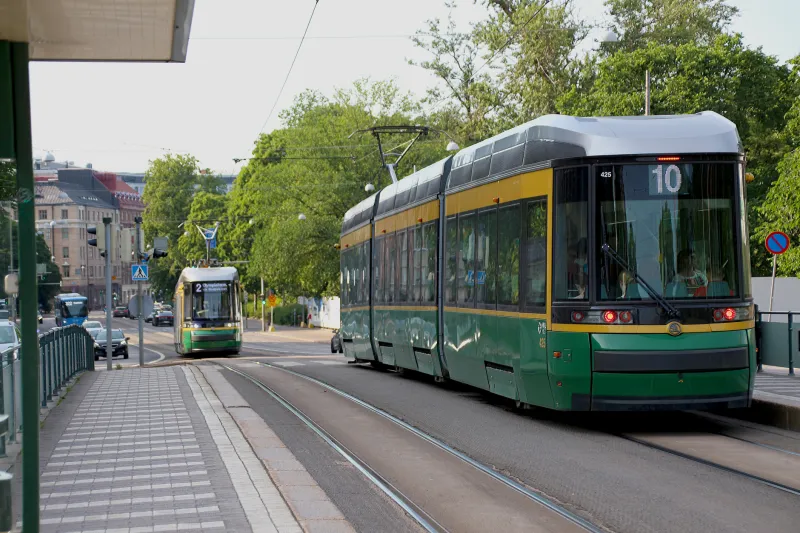
Tampere operates an integrated public transportation network administered through Nysse, the regional transit authority serving the Tampere city region. The system encompasses tram lines, urban bus routes, and regional connections — all coordinated under a unified ticketing and scheduling framework.
The environmental performance of this network begins with energy sourcing. Tampere has made substantial commitments to renewable electricity, and the city's tram system runs on power drawn from a grid increasingly dominated by wind, hydroelectric, and nuclear sources. Finland as a whole generates a significantly lower share of its electricity from fossil fuels compared to the United States, where the national grid remains more carbon-intensive.
When measured on a per-passenger-kilometer basis — the standard unit used by transportation researchers — electric trams in cities like Tampere emit approximately 30 to 60 grams of CO₂ equivalent per kilometer, depending on grid composition and occupancy rates. Diesel buses, which still operate portions of the Tampere network, perform less impressively in isolation but remain far cleaner than single-occupancy vehicles when passenger loads are factored in.
By comparison, a single-occupancy gasoline car in the United States emits roughly 271 grams of CO₂ per passenger-kilometer. The gap is not marginal. It is transformational.
Why Occupancy Changes Everything
One of the most important variables in any emissions comparison is vehicle occupancy. A bus carrying 40 passengers distributes its fuel consumption — and its emissions — across all 40 riders. A car carrying one person concentrates the entire environmental cost on a single individual.
Tampere's transit system is engineered to maximize this efficiency. Routes are designed around actual ridership patterns, with higher-frequency service on corridors where demand is strongest. The tram network, which serves the city's densest and most heavily trafficked corridors, achieves occupancy rates that make per-rider emissions genuinely competitive with almost any mode of ground transportation.
In the United States, average vehicle occupancy for commuting sits at approximately 1.1 persons per car. That figure has remained stubbornly low for decades, despite various policy efforts to encourage carpooling. Finnish public transit, by design, sidesteps this problem entirely.
The Infrastructure Multiplier
Beyond the emissions generated during operation, transportation infrastructure carries what researchers call embodied carbon — the greenhouse gases released during the construction and maintenance of roads, parking structures, vehicles, and related systems.
The American model of car-centric urban development is extraordinarily resource-intensive. Wide arterial roads, vast parking lots, highway interchanges, and suburban sprawl all require enormous quantities of concrete, asphalt, and steel to build and maintain. Each of these materials carries a significant carbon cost before a single vehicle ever turns a wheel.
Tampere's approach to urban mobility is more compact by design. The tram network operates on a relatively modest physical footprint, sharing street-level infrastructure with pedestrians and cyclists in many corridors. The city's denser urban form — a product of both geography and deliberate planning — reduces the total distance residents must travel to access employment, services, and amenities. Shorter trips, even by car, produce fewer emissions. But when those shorter trips are made by transit, the savings compound further.
What the Visitor Experience Reveals
For American travelers spending time in Tampere, the environmental dimension of the transit system is rarely the first thing that registers. The initial impression is more likely to be practical: the reliability of the trams, the clarity of the route maps, the ease of purchasing a ticket through a mobile application.
But the cumulative effect of choosing transit over a rental car for a week in Tampere is measurable. A visitor who relies entirely on Nysse services during a seven-day stay — commuting between accommodations, cultural sites, restaurants, and the airport — might generate as little as two to four kilograms of transit-related CO₂ over that period. The same itinerary completed by rental car could easily produce 20 to 40 kilograms or more, depending on distance and vehicle type.
That difference, replicated across thousands of visitors annually, represents a meaningful aggregate reduction in the city's tourism-related carbon output.
Reconsidering the Default
The broader implication of Tampere's transit performance is not that American cities are incapable of improvement — several U.S. metropolitan areas have made genuine progress on transit investment and electrification — but rather that the default assumption of car dependency carries costs that are rarely made explicit at the individual level.
When a commuter in Atlanta or Phoenix or Houston climbs into a car each morning, the carbon consequence of that choice is largely invisible. There is no meter on the dashboard displaying grams of CO₂ per mile. The environmental cost is real, but it is diffuse and deferred.
Tampere's transit system makes the alternative visible and accessible. Riders do not need to calculate emissions or consult research papers. They simply purchase a ticket, board at the scheduled time, and arrive at their destination — having contributed, in a concrete and quantifiable way, to a lower-carbon form of urban mobility.
For American visitors accustomed to the car as the only viable option, that experience can be genuinely revelatory. The question it tends to raise — why can't we do this at home? — is one that transit advocates, urban planners, and policymakers across the United States are still working to answer.