Benchmarking Brilliance: How Tampere's Transit System Consistently Outperforms Boston, Chicago, and San Francisco
American commuters have grown accustomed to a particular kind of resignation — the delayed subway announcement, the bus that simply does not arrive, the hour-long crawl across a city that spans only a few miles. For many US residents, these experiences are not anomalies. They are the baseline. Tampere, Finland's third-largest city, operates under an entirely different set of expectations, and the numbers that underpin its transit network reveal just how wide that gap has become.
Setting the Stage: Comparing Cities of Different Scales
Fair comparisons require context. Tampere's population of approximately 250,000 within the city proper — and roughly 400,000 across the broader urban region — places it well below the scale of Boston, Chicago, or San Francisco. Critics are quick to invoke this difference as a disqualifying factor. However, population density and geographic complexity do not fully explain the performance disparities at hand. Many of the structural advantages Tampere enjoys stem from deliberate policy choices rather than favorable demographics, and those choices are replicable regardless of city size.
Boston's MBTA, for instance, serves a region of approximately 4.9 million people, yet its on-time performance on key subway lines has hovered around 70 to 75 percent in recent years, according to figures published by the Massachusetts Bay Transportation Authority itself. Chicago's CTA has reported similar figures, with certain elevated rail lines falling below the 80 percent threshold during peak periods. San Francisco's BART system, despite serving one of the wealthiest metropolitan economies in the world, has faced chronic delays, aging infrastructure, and fare recovery challenges that have persisted for decades.
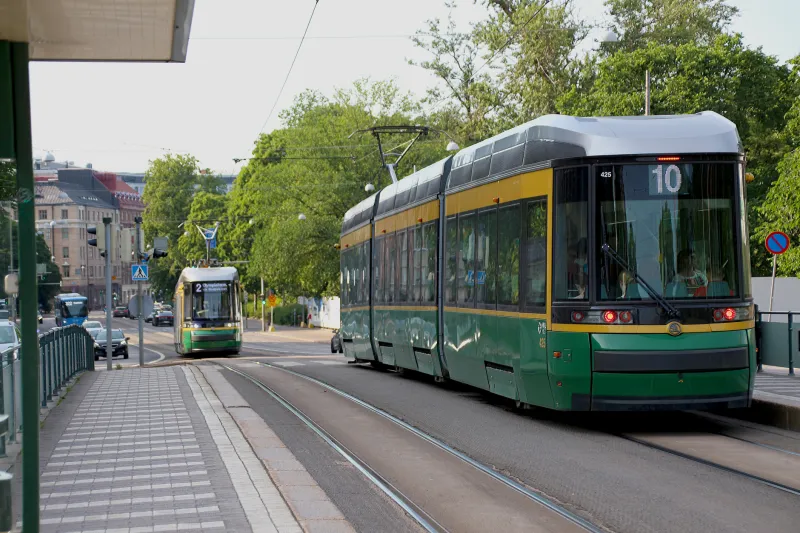
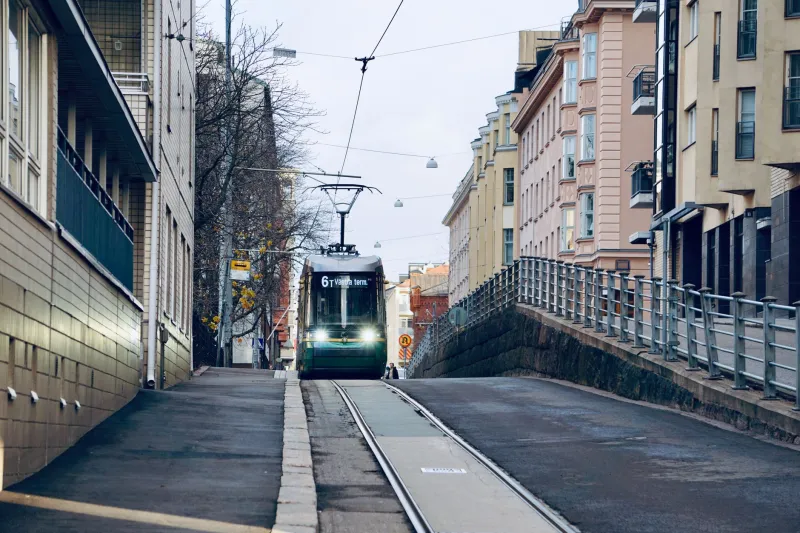
Tampere's Nysse network — the regional public transport authority overseeing bus and tram services — consistently reports punctuality rates above 90 percent across its core routes. The tram network, inaugurated in 2021 and now a cornerstone of urban mobility in the city, operates with a precision that passengers on Boston's Green Line or San Francisco's Muni system would find difficult to imagine as routine.
The Commute Time Equation
Average commute duration is one of the most tangible metrics by which transit systems are judged. In Chicago, the average one-way commute time sits at approximately 34 minutes, according to US Census data — a figure that masks significant variation depending on whether a commuter relies on the CTA or drives. In San Francisco, that average climbs closer to 37 minutes, with transit-dependent commuters frequently reporting journeys well in excess of 45 minutes for trips that span only a few miles.
Tampere's average commute time, by contrast, falls in the range of 20 to 25 minutes for most urban residents using public transit. This is not simply a function of the city's smaller footprint. It reflects a network designed around frequency and connectivity rather than coverage alone. Routes are calibrated to minimize transfer time, and the tram system's dedicated right-of-way means that surface traffic does not introduce the unpredictability that plagues bus-heavy systems in American cities.
The practical implication for a commuter is significant. A resident of Tampere who takes public transit to work loses, on average, far fewer productive hours per week to travel than a counterpart in any of the three American cities cited above.
Infrastructure Investment as a Policy Signal
One of the most instructive contrasts between Tampere and its American counterparts lies in how infrastructure spending is framed politically and culturally. In the United States, public transit investment is frequently debated through the lens of fiscal burden — a cost to be minimized rather than a service to be optimized. The result is a pattern of deferred maintenance, underfunded capital programs, and systems that deteriorate faster than they are renewed.
Finland's approach treats transit infrastructure as a foundational public good, comparable in status to roads, schools, and utilities. Tampere's tram network, which required an investment of approximately 300 million euros, was approved and executed with a long-term return-on-investment framing that accounted for reduced road congestion, lower emissions, and the economic productivity gains associated with reliable commuting. The city did not build the tram because it was cheap. It built it because the broader calculus — environmental, economic, and social — justified the expenditure.
For comparison, Boston's Green Line Extension project, which added a modest 4.7 miles of track, ultimately cost approximately 2.3 billion dollars after years of delays and cost overruns. The per-mile cost differential between these two projects speaks not only to construction efficiency but to the institutional capacity and political will that each system commands.
Fare Structures and Cost-Efficiency
The affordability dimension of this comparison deserves its own scrutiny. A single-ride fare on the MBTA in Boston costs $2.40 for subway travel. In Chicago, the base CTA fare is $2.50. San Francisco's BART charges distance-based fares that can reach $6.00 or more for cross-bay trips. These prices exist within systems that, despite their cost to riders, still require substantial public subsidy to remain operational — and still underdeliver on reliability.
Tampere's Nysse network offers a single-zone fare of approximately 3.20 euros for a standard adult ticket, with significant discounts available through season passes and the Nysse mobile application. Season pass holders — the equivalent of monthly commuters — pay rates that represent a fraction of what Boston or Chicago riders spend annually. Crucially, the value proposition is not merely cheaper. It is cheaper and more reliable, a combination that American transit advocates have long argued is achievable but rarely demonstrated at scale.
Cultural and Policy Differences That Drive Performance
Data points do not exist in a vacuum. Behind Tampere's performance metrics lies a set of cultural and institutional conditions that help explain why the numbers look the way they do.
First, Finnish public policy treats transit as a right rather than a market product. Service levels are not determined primarily by fare revenue but by a broader mandate to provide equitable mobility to all residents. This insulates the system from the revenue-driven service cuts that have periodically gutted American transit networks during economic downturns.
Second, land use policy in Tampere actively supports transit ridership. New residential and commercial developments are evaluated in part on their transit accessibility, creating a feedback loop in which density and service reinforce each other. American cities, by contrast, have frequently zoned in ways that make transit use impractical for large segments of the population, then wondered why ridership remains low.
Third, and perhaps most fundamentally, there is a political consensus in Finland around the value of public services that does not have a direct equivalent in American civic culture. Transit funding does not become a flashpoint in the same way, and that stability allows planners to make long-term investments with confidence.
What the Data Asks of American Cities
This comparison is not offered as an exercise in national self-criticism. It is presented because the performance gap is real, measurable, and — in meaningful ways — closeable. Tampere is not an outlier produced by unique geographic or demographic luck. It is a city that made deliberate choices about infrastructure, policy, and institutional design, and those choices produced measurable results.
For American commuters who have spent years navigating delayed trains and unreliable bus schedules, Tampere's transit record represents something concrete: proof that the alternative is not merely theoretical. The benchmarks exist. The methodology is documented. The question that remains is whether the political and cultural conditions necessary to replicate them can be assembled.
For those traveling to Tampere, the experience of boarding a tram that arrives on schedule, connects efficiently to a broader network, and delivers passengers to their destination without incident is itself a form of evidence. It is transit functioning as it was designed to function — and that, in the current American context, remains a genuinely radical thing to witness.